
Webster Parish Projected Versus Actual Release
A projected release date is a sentence-computation estimate. It is not proof that someone left Bayou Dorcheat Correctional Center, Webster Parish Jail, a state facility, or the Webster Parish Transitional Work Program. Court paperwork, jail credit, good-time eligibility, earned credits, forfeitures, another hold, and later court action can affect the estimate.
An actual release date records the custody event after it occurs. Even then, the disposition matters. Release to parole or good-time supervision is physical release with a state obligation still in force. Transfer means the person went to another custodian. Full discharge is the later end of the DPS&C custody or supervision term.
A pretrial detainee is different. Before a sentence, no corrections calculation can predict the court, bond process, charging decision, or effect of another warrant. A bond order may precede the jail's administrative departure, and a court calendar entry does not supply an exit time.
Find Webster Parish Projected Release Dates
Start by deciding whether the person is a local detainee, a person serving a parish sentence, or a person committed to Louisiana DPS&C custody. A state-sentenced person can remain physically housed in a Webster Parish facility, so the building name does not always identify the agency responsible for the time calculation.
- Check the sheriff-linked current roster only to identify present Webster Parish custody. A missing name does not prove release.
- For a pretrial or local case, ask the Webster Parish Sheriff's Office for the booking and custody record, then check the Webster Clerk for the controlling court action.
- For a DPS&C sentence, call the automated Imprisoned Person Locator at 225-383-4580 with the DPS&C number or the person's name and date of birth.
- Record the exact “projected release date” returned, if applicable, and the date of the call.
- If no calculation is available, allow for court paperwork and contact the proper facility or time-computation route rather than estimating it.
- After the expected date, seek the actual release, disposition, or discharge record.
The DPS&C Inmates and Families page is the official source for the locator and projected-date instructions. The telephone system is the clearest verified public channel for the calculated field. Research did not verify a stable public web-result screen that always displays it.
The state page directs users to the locator, while a Webster Parish booking and release remains a separate sheriff record.
For broader custody and record checks, use the Webster Parish released-inmate search path without substituting a current roster for proof of release.
Webster Parish Release Date Calculation
DPS&C must first receive official sentencing paperwork before a new state calculation can be completed. If the automated system gives no date, that may mean the record is still being built. Time-computation questions may also go to the department's automated line at 225-342-0799. The confined person's Master Prison Record is the authoritative calculation record, not a home-made estimate.
A Webster Parish caller should keep the lookup inputs close to the source record. The DPS&C number is the strongest identifier. If it is not known, the locator accepts the person's name and date of birth. A court case number may help when the sentencing clerk must confirm that paperwork was sent, but it should not be substituted for the state identifier when the department asks for its own number.
The inputs can include the imposed sentence, credit for time already held, the offense date, eligibility for diminution of sentence, earned program credits, forfeitures, and later court action. “Diminution” means a lawful reduction in time based on the governing credit rules. DPS&C says program-completion credits can take up to 90 days to post, though they are often added within a few weeks and are prioritized by discharge date.
- Jail credit
- Time credited by law or court order for custody before the sentence calculation.
- Good time
- A sentence reduction that may be earned under the statute applicable to the offense date and conviction.
- Earned credit
- A possible reduction tied to an eligible certified program or degree, subject to statutory limits.
- Detainer
- A request or hold from another authority that may prevent community release from the current facility.
No Webster-specific jail calculator, weekend rule, or parish good-time policy was found. Applying another parish's practice would be unsupported. The Webster Parish Jail, Bayou Dorcheat, and the co-located transitional-work program also must not be treated as one interchangeable record source. Only the responsible custodian can state which calculation governs the person.
Current Webster Parish Good-Time Rule
For an offense committed on or after August 1, 2024, Louisiana Revised Statutes 15:571.3.1 supplies the ordinary good-time framework. A qualifying felony sentence in parish prison or DPS&C custody may earn up to 15 percent of the imposed sentence for good behavior. The rule excludes a sex-offense conviction as defined by law and a sentence imposed under the habitual-offender statute. It also says ordinary good time is not earned on pre-sentence custody credited under Code of Criminal Procedure article 880.
The familiar 85 percent figure comes from subtracting the maximum 15 percent ordinary reduction. It is not a promise that every Webster Parish sentenced person leaves after exactly 85 percent of the calendar term. Exclusions, jail credit, court restrictions, earned program credits, forfeiture, and special laws still affect the official calculation.
Read the current maximum-15-percent statute alongside the page-matched capture.
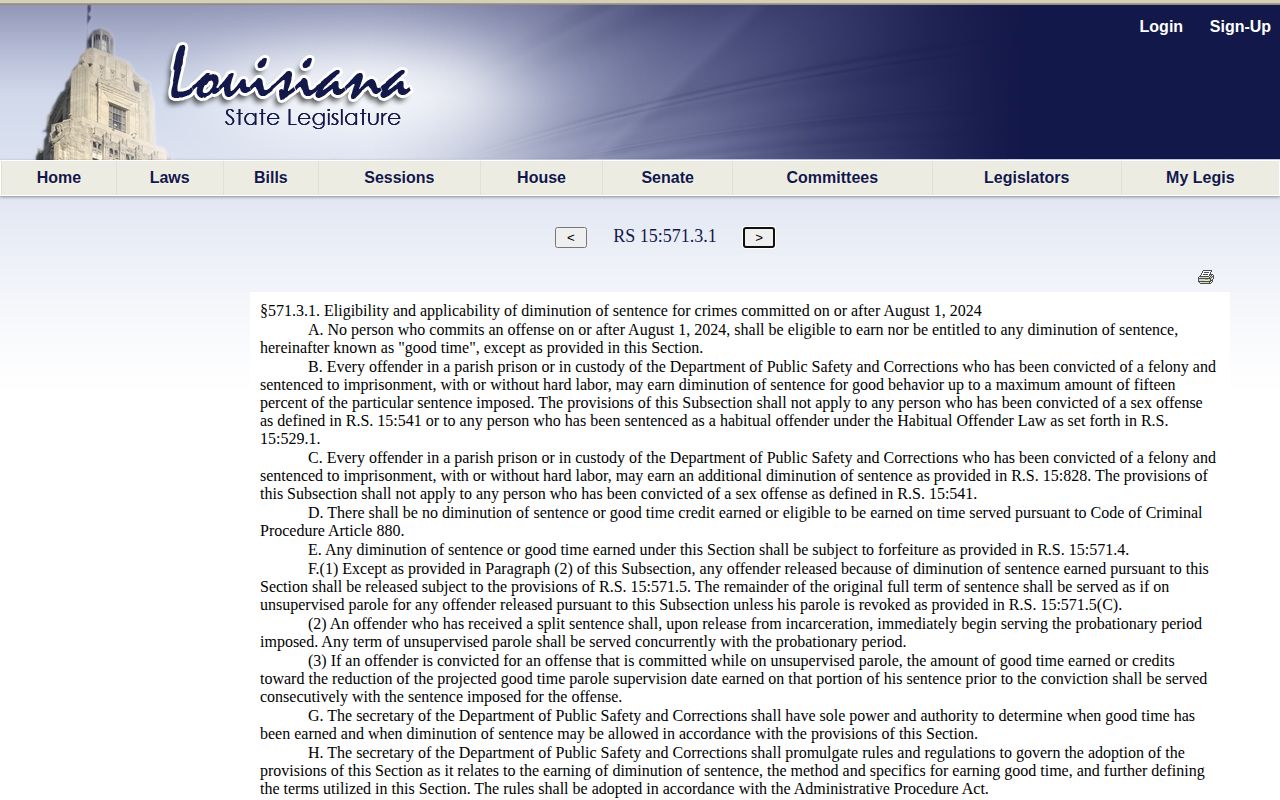
The statute supports the post-cutoff rule, but only the official record applies the full set of facts to one sentence.
Note: Do not use 85 percent as a do-it-yourself calculator; first establish the offense date, sentence type, exclusions, and posted credits.
Earlier Webster Parish Release Rules
Offenses before August 1, 2024 remain under the earlier, date- and category-dependent framework in Louisiana Revised Statutes 15:571.3. One part addresses qualifying parish-prison sentences without hard labor through a 30-days-for-30-days formula, with a different three-days-for-17-days rule for a first crime-of-violence conviction. Other subsections carry other limits and exclusions.
Those older ratios must not be moved onto a post-cutoff offense just because the person is housed in a parish facility. Subsection H directs that an offense on or after the cutoff earns no good time except through the newer statute. A Webster Parish record therefore needs the offense date and conviction category before any older rule can even be identified.
Open the earlier-offense good-time statute before reading the corresponding capture.
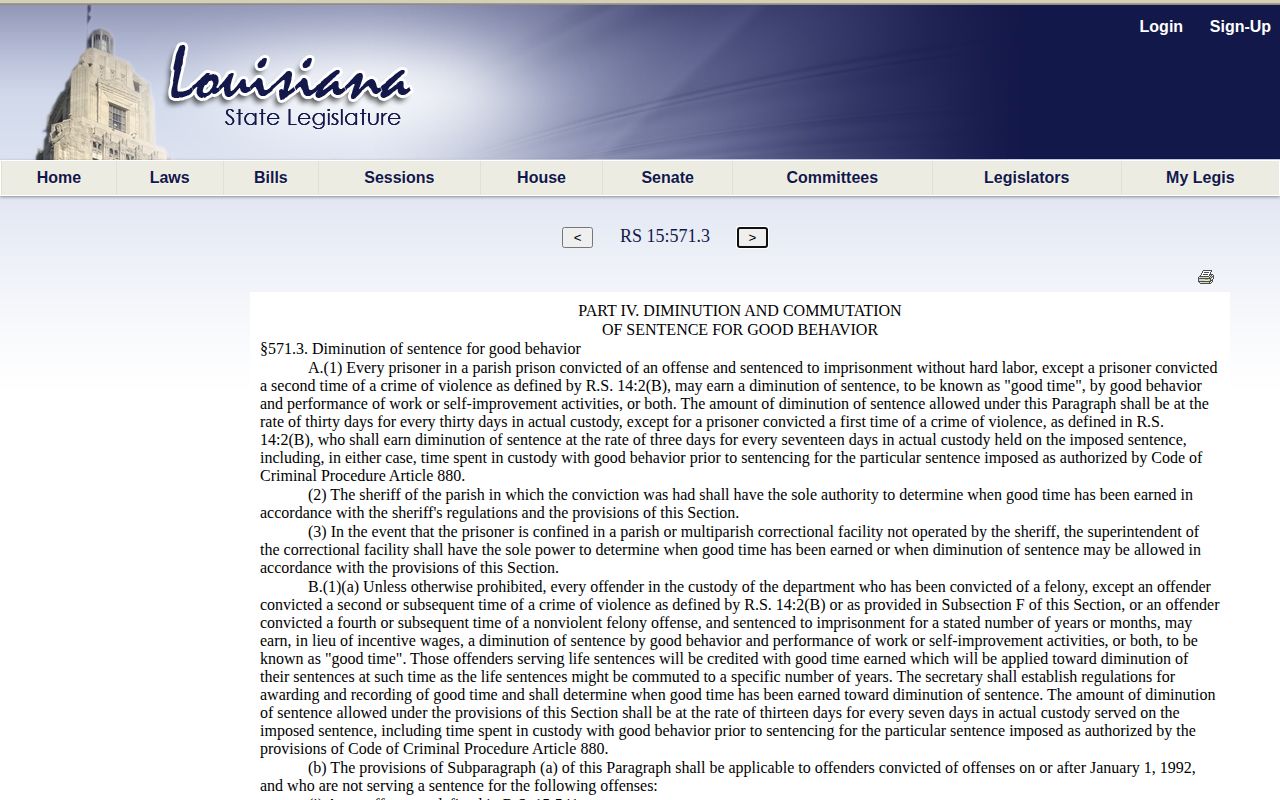
The earlier statute shows why one broad percentage cannot describe every Louisiana sentence.
Webster Parish Program Release Credits
Louisiana Revised Statutes 15:828 authorizes certified treatment and rehabilitation programs and uses the phrase “projected good time parole supervision date.” An eligible person may receive up to 360 total days of earned credit toward that date. Completion does not prove the maximum credit was awarded or posted.
The statute has its own eligibility rules. It may allow some people who cannot receive ordinary good time to earn program credit, including certain habitual offenders, while excluding specified sex-offense and repeat violent-offense circumstances. It also addresses possible extra credit for eligible workforce-development work release and degree completion. The controlling Master Prison Record must show what was actually applied.
Review the certified-program credit statute displayed in the matching image.
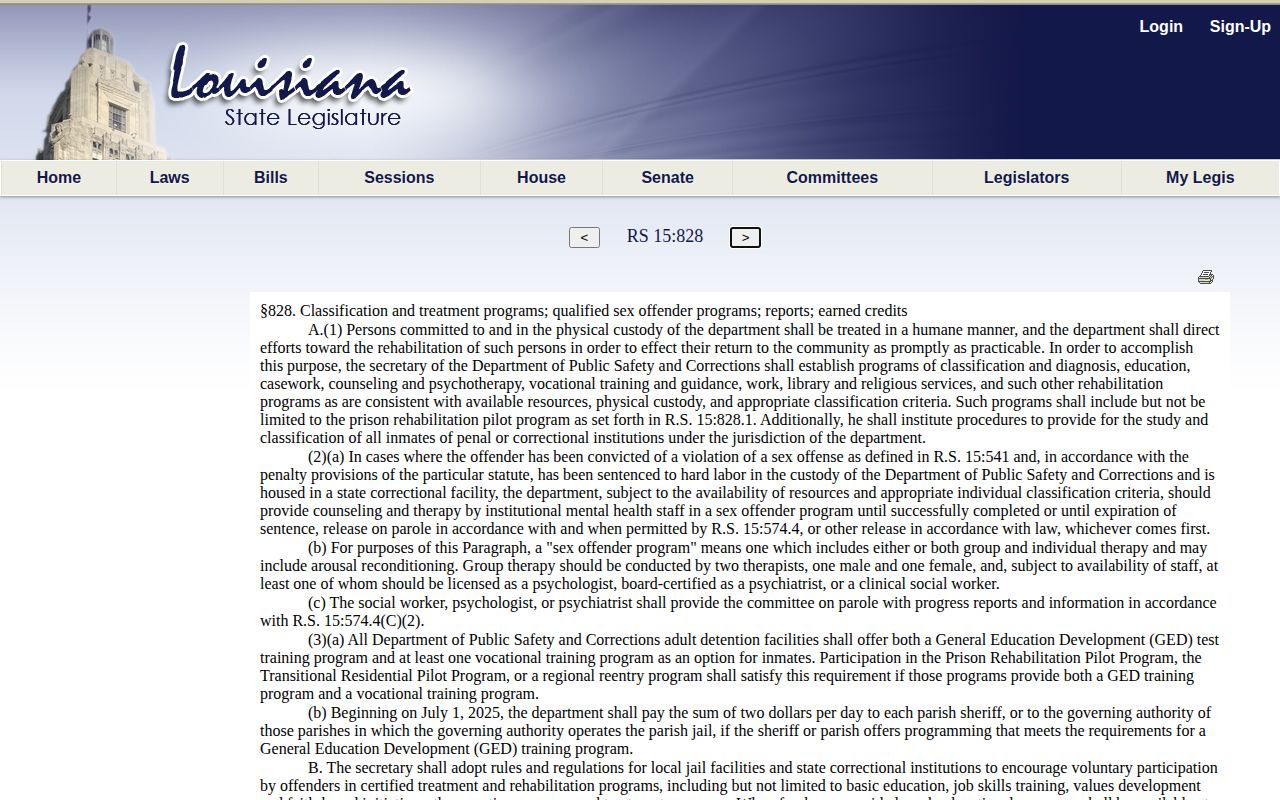
The law creates possible credit, not a guaranteed date based on enrollment alone.
Why Webster Parish Release Dates Change
A projected date can move as the official record changes. Some events alter the sentence computation. Others do not change the arithmetic but prevent release from becoming a community departure. The record should identify which type of event occurred.
| Factor | Possible effect | Where to verify |
|---|---|---|
| Late court paperwork | Delays the first complete calculation | Sentencing court and DPS&C |
| Jail credit correction | Changes credited time | Court order and Master Prison Record |
| Program credit posting | May move an eligible date earlier | DPS&C calculation record |
| Credit forfeiture | May move the date later | Facility and DPS&C record |
| Detainer or warrant | Can cause transfer instead of community release | Holding and receiving agencies |
| Parole action | May affect supervised release, but eligibility or a grant alone is not an exit | Committee result and DPS&C custody record |
| Later court order | Can alter the sentence or custody basis | Webster Clerk and sentencing court |
Parole and good time are distinct. For many qualifying pre-cutoff offenses, an eligibility statute refers to consideration after part of a sentence, subject to major exclusions. For offenses on or after August 1, 2024, Louisiana law generally bars parole under that Part except for listed special populations. Eligibility means the Committee may consider a case. It does not guarantee release.
Confirm Webster Parish Actual Release
After the estimated date, ask the record owner what happened. A local Webster Parish event is confirmed by the sheriff's release date, time, disposition, and destination, plus the court record when needed. A state-custody event can be checked through DPS&C. Louisiana Revised Statutes 15:574.12(G) expressly makes the state discharge date and other specified general information available on request even though the complete prison file is confidential.
For future custody changes, the Webster Parish VINELink inmate search explains local alerts and the separate DPS&C Victim Outreach enrollment. An alert still needs agency confirmation. A person released on parole remains in legal custody and under supervision, while a discharge date marks completion of that state obligation.
Use precise labels: projected date, parole eligibility, parole grant, release to supervision, transfer, actual release, or full discharge. Each answers a different question. That care prevents a planned Webster Parish date from being repeated as an event that never occurred.
Note: If an official date is disputed, the confined person uses facility records and the Administrative Remedy Procedure for the computation issue.